
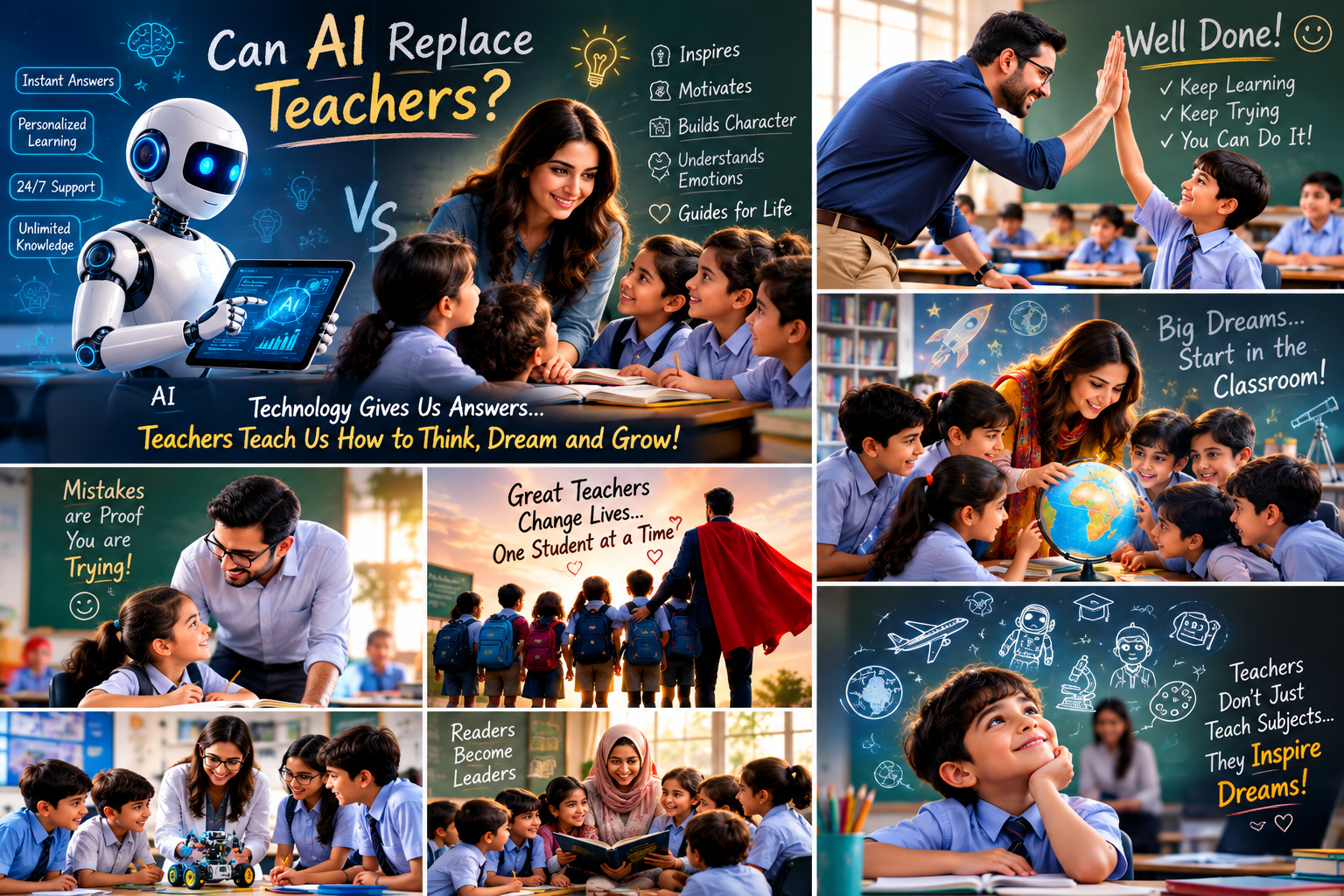
Artificial intelligence is no longer something we only see in science-fiction movies. It is already changing the way we work, communicate, create content, analyse information, and learn. From AI-powered tutoring apps to Chabot’s that can explain complicated subjects in seconds, technology is becoming a regular part of education.
That raises an uncomfortable but important question: Can AI replace teachers?
OFCOUSE NOT.
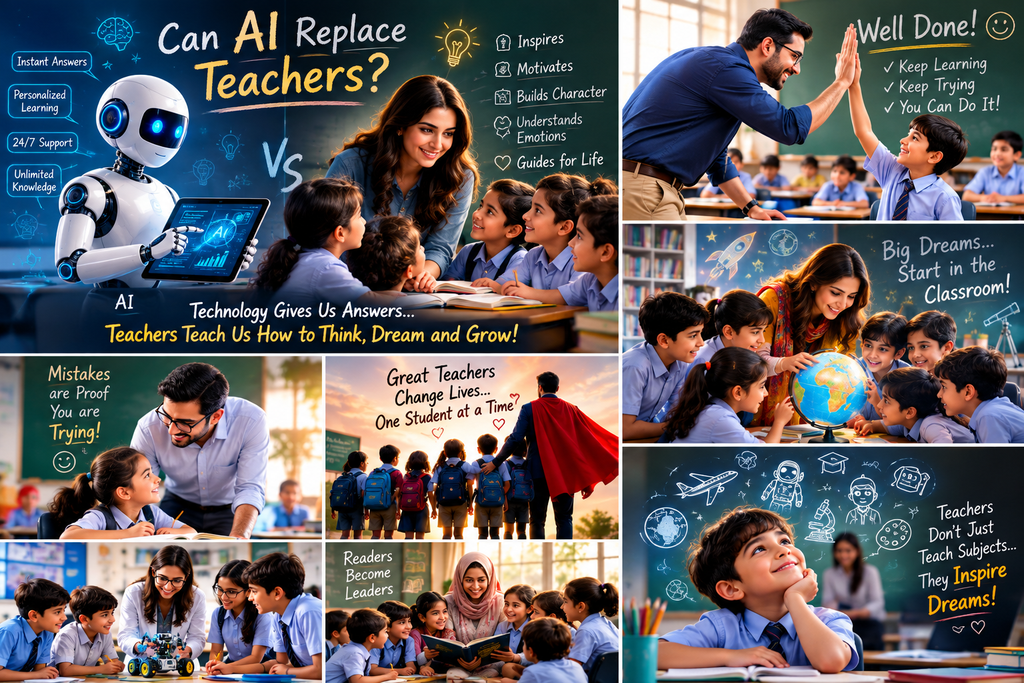
AI can certainly automate many tasks teachers perform. It can explain concepts, create quizzes, provide instant feedback, personalize learning materials, translate content, and even help students practice difficult subjects. But teaching is about much more than delivering information. A good teacher understands emotions, builds confidence, notices when a student is struggling, encourages curiosity, manages a classroom, and creates human connections.
Think of AI as a powerful educational assistant. It may be able to carry a huge toolbox, but it does not necessarily know which tool a child needs at a particular moment.
So, rather than asking whether AI will eliminate teachers, perhaps the better question is: How will AI change the role of teachers?
What Is Artificial Intelligence in Education?
Artificial intelligence in education refers to the use of AI technologies to support teaching, learning, assessment, administration, and educational decision-making.
AI systems can analyse enormous amounts of information quickly. For example, an AI learning platform might identify that a student repeatedly struggles with fractions and automatically provide additional exercises.
Other systems can generate lesson plans, summarize learning materials, answer student questions, create assessments, or provide language support.
The technology is becoming increasingly sophisticated. However, sophistication should not be confused with human understanding.
AI can recognize patterns in data. Teachers recognize patterns in people.
That difference matters.
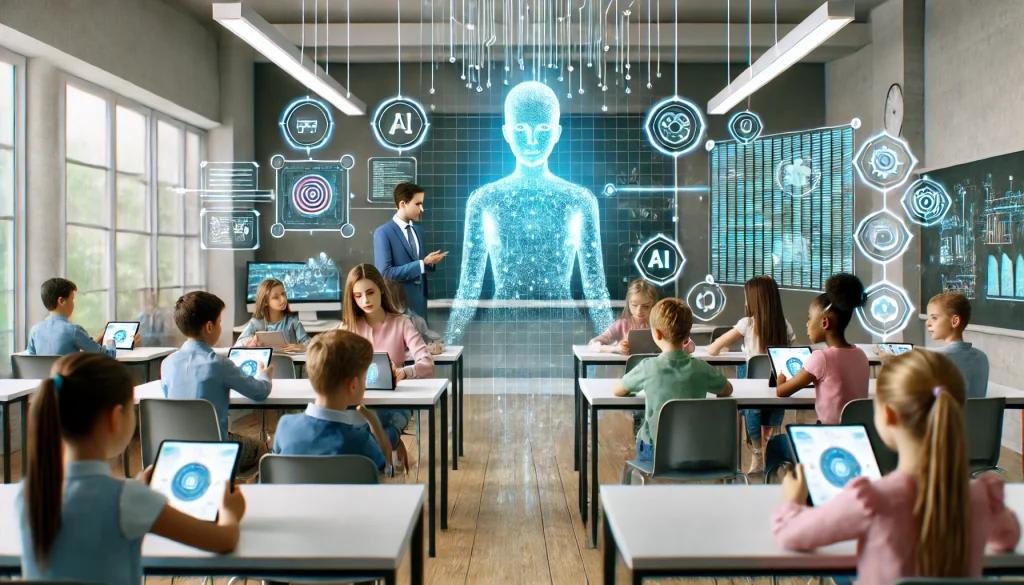
Why Are People Asking If AI Can Replace Teachers?
There are several reasons this debate has become so popular.
First, AI can now perform tasks that once required considerable human effort. A student can ask an AI system to explain photosynthesis, solve a mathematical problem, generate examples, or create a study plan.
Second, AI operates around the clock. Students do not have to wait until the next school day to ask a question.
Third, AI can potentially support thousands or even millions of learners simultaneously.
And fourth, schools and educational institutions are increasingly interested in technology that can improve efficiency.
This naturally creates anxiety among educators.
If an AI system can answer questions, generate worksheets, grade certain assignments, and personalize learning, what exactly will teachers do?
The answer is simple: teachers will increasingly focus on the parts of education that machines struggle to reproduce.
Can AI Actually Teach Students?
Yes, AI can teach students certain things.
It can explain a concept in different ways. If a student does not understand a scientific definition, AI can simplify it, provide an analogy, create examples, or turn it into a step-by-step explanation.
Imagine a student saying, “I don’t understand this.”
A traditional textbook might provide the same explanation again.
An AI tutor can potentially respond with another explanation immediately.
That flexibility is powerful.
However, teaching is not merely explanation. A student may understand the information but still lack motivation. Another may know the answer but be afraid to participate. Someone else may be dealing with family difficulties, anxiety, social pressure, or a lack of confidence.
AI may detect some behavioural patterns, but it cannot replace genuine human relationships.
The Strengths of AI Teachers
AI has several impressive advantages that could transform education.
1. Personalized Learning
Every student learns differently.
Some students understand mathematics quickly but struggle with reading. Others need visual examples. Some learn through repetition, while others need practical activities.
AI can analyse a learner’s performance and adapt educational content accordingly.
Instead of giving every student exactly the same exercise, an AI-powered system could provide different levels of difficulty.
That is one of the biggest opportunities AI offers education.
2. Instant Feedback
Imagine completing 20 mathematics questions and receiving immediate feedback.
AI can identify mistakes, explain them, and generate additional practice questions.
Students do not necessarily need to wait for a teacher to mark every exercise.
This does not eliminate teachers. Instead, it can give teachers more time to focus on higher-value interactions.
3. 24/7 Learning Support
Teachers have working hours.
AI does not need to sleep.
A student studying at 11 p.m. could ask an AI tutor for an explanation. Someone preparing for an examination during the weekend could receive practice questions instantly.
For students who have limited access to tutoring, this could be especially valuable.
4. Administrative Assistance
Teachers spend significant time on administrative work.
Lesson planning, creating worksheets, writing questions, organizing resources, preparing rubrics, and summarizing student performance can consume valuable hours.
AI can help automate some of these tasks.
Imagine getting several hours back every week.
For teachers, that time could be redirected toward students.
The Human Qualities AI Cannot Easily Replace
Now we reach the heart of the debate.
Teaching is a deeply human profession.
A teacher does not simply transfer knowledge from one brain to another. A teacher influences attitudes, behaviour, confidence, discipline, curiosity, and character.
Empathy
Suppose a normally active student suddenly becomes quiet.
A teacher who knows that student may notice immediately.
Perhaps something happened at home.
Perhaps the student is being bullied.
Perhaps they simply need someone to listen.
AI may notice that participation has declined. But recognizing the deeper human reason requires context, experience, empathy, and trust.
Motivation
Sometimes students do not need another explanation.
They need someone to say:
“You can do this. Try again.”
A teacher can turn failure into motivation.
That emotional encouragement can become a memory that stays with a student for years.
Classroom Management
Teaching 30 students simultaneously is not the same as tutoring one person through a Chabot.
Classrooms are dynamic environments.
Students talk. They argue. They laugh. They become distracted. They collaborate. They make mistakes. They develop friendships.
Teachers must constantly make decisions.
Who needs help?
Who is disengaged?
Who is dominating the discussion?
Who is being excluded?
Who needs additional encouragement?
AI may assist with some of these processes, but human judgment remains essential.
AI Can Be a Teacher’s Assistant, Not a Teacher’s Replacement
One of the most realistic scenarios is not AI versus teachers.
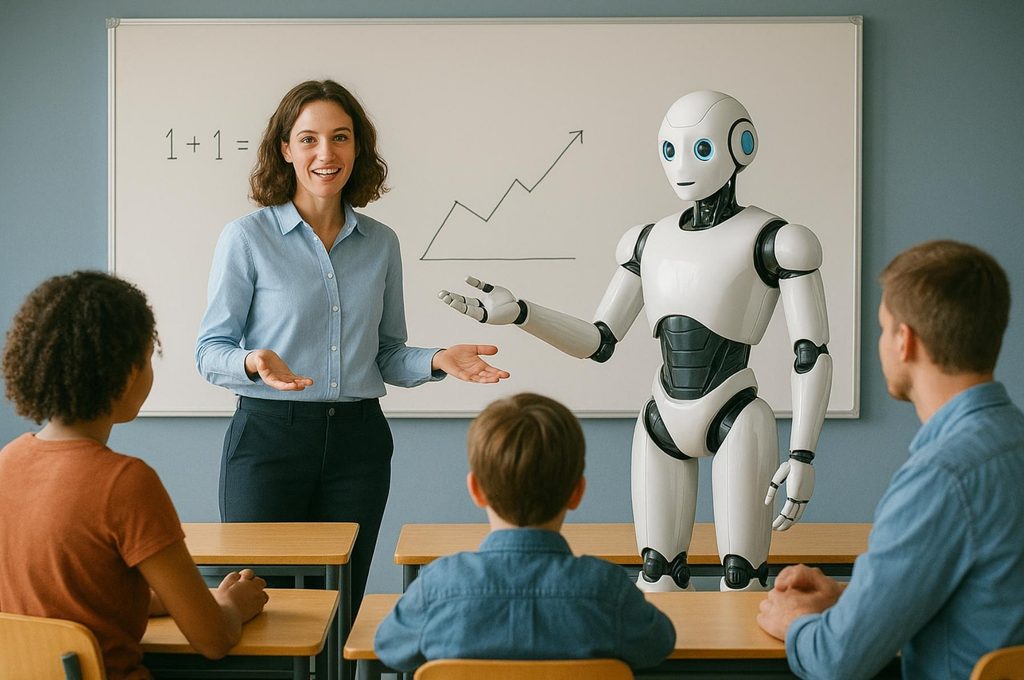
It is AI plus teachers.
Think about a pilot and an aircraft’s automated systems.
Modern aircraft can perform remarkable tasks automatically, but trained pilots remain responsible for decisions, judgment, safety, and unexpected situations.
Education could move in a similar direction.
AI can handle repetitive educational tasks while teachers concentrate on human-centred responsibilities.
For example, AI might prepare a first draft of a lesson plan.
The teacher reviews it.
AI might generate a quiz.
The teacher checks whether the questions actually match the students’ level.
AI might analyse performance data.
The teacher decides how to respond.
The human remains in the loop.
Will AI Replace Some Teaching Jobs?
This is a more complicated question.
AI is likely to automate some teaching-related tasks.
Certain forms of basic tutoring, standardized feedback, administrative preparation, and content generation could increasingly be handled by AI.
That does not necessarily mean the teaching profession disappears.
Instead, the profession may change.
History gives us plenty of examples.
When calculators became common, mathematics education did not disappear.
When search engines became popular, teachers did not become unnecessary.
When online courses expanded, schools did not vanish.
Technology tends to change jobs rather than simply erase them.
The same may happen with AI.
The Role of Teachers Could Become More Important
Here is the interesting twist.
AI may actually make excellent teachers more valuable.
Why?
Because information is becoming cheaper.
Students can already find enormous amounts of information online.
AI makes information even easier to access.
When information is everywhere, knowing what to do with information becomes more important.
Teachers can help students evaluate evidence, question assumptions, communicate ideas, work with others, solve problems, and develop judgment.
In other words, the teacher’s role can move from being primarily an information provider to becoming a mentor, coach, facilitator, and critical-thinking guide.
Can AI Understand Every Student?
Not perfectly.
AI can analyse data such as test scores, response times, attendance patterns, and completed assignments.
But a student’s life is bigger than a spreadsheet.
Two students could receive identical test scores for completely different reasons.
One might be naturally confident.
Another might be extremely anxious.
One may have strong support at home.
Another may be studying under difficult circumstances.
Teachers often learn these contextual details through relationships and everyday interaction.
That human context can dramatically influence how education should be delivered.
The Problem of AI Errors
AI is powerful, but it is not infallible.
AI systems can produce incorrect information, misunderstand questions, invent references, or present an inaccurate answer with impressive confidence.
That creates a serious educational challenge.
A student may think:
“If the AI said it, it must be correct.”
But that assumption can be dangerous.
Teachers can teach students an essential skill: question the answer.
That may become one of the most important educational skills in the AI era.
AI and Critical Thinking
If students use AI to answer every question, they may become dependent on it.
Imagine using a calculator for every simple calculation without ever learning basic arithmetic.
The tool becomes a crutch.
Similarly, if students ask AI to write every essay, solve every problem, summarize every book, and generate every idea, they may miss the learning process itself.
Education is not just about producing correct answers.
It is about learning how to think.
Teachers will therefore have an increasingly important role in teaching students when to use AI, how to verify its output, and when to think independently.
Academic Integrity in the Age of AI
AI has also created a new challenge for schools: cheating.
A student can potentially ask AI to write an assignment in seconds.
This forces educators to rethink traditional homework and assessment methods.
Instead of relying entirely on take-home written assignments, teachers may increasingly use:
- Classroom discussions
- Presentations
- Projects
- Oral examinations
- Practical demonstrations
- Collaborative activities
- Personalized questioning
- Draft-and-revision processes
The goal should not simply be to catch students using AI.
The goal should be to design education where learning matters more than submitting a perfect-looking answer.
How Teachers Can Use AI Effectively
Teachers do not need to fear AI.
They need to learn how to use it responsibly.
AI can help educators brainstorm lesson ideas, create differentiated activities, generate discussion questions, develop quizzes, simplify reading materials, and prepare classroom resources.
But teachers should remain the final decision-makers.
Before using AI-generated material, educators should check:
- Is the information accurate?
- Is it appropriate for the students’ age?
- Does it match the curriculum?
- Is the language culturally appropriate?
- Could the content contain bias?
- Does it encourage genuine learning?
AI should accelerate good teaching, not replace professional judgment.
What Will the Classroom of the Future Look Like?
The classroom of the future may look surprisingly familiar.
There could still be desks, books, teachers, group discussions, experiments, sports, art, and school activities.
The difference may be the invisible technology supporting the classroom.
A student could have an AI learning assistant that identifies areas requiring additional practice.
The teacher could receive a dashboard showing which concepts the class is struggling with.
AI could generate differentiated resources for different learning levels.
Meanwhile, the teacher could spend more time working directly with students.
The classroom could become more personalized without becoming less human.
Will AI Replace Teachers by 2030?
Predicting an exact date is impossible.
Technology develops faster than many forecasts anticipate, while education systems often change slowly because schools must consider safety, budgets, training, regulations, parents, students, and cultural expectations.
AI will almost certainly become more capable by 2030.
But replacing teachers entirely would require AI to reproduce far more than academic knowledge.
It would need reliable empathy, moral reasoning, social awareness, leadership, contextual judgment, emotional intelligence, and the ability to build authentic relationships.
That is a much bigger challenge than answering questions.
What Skills Will Future Teachers Need?
Teachers of the future will need more than subject knowledge.
They will increasingly need:
AI Literacy
Teachers should understand what AI can and cannot do.
Digital Citizenship Skills
They will need to teach students responsible technology use, privacy awareness, and ethical behaviour.
Critical Thinking
Teachers must help students distinguish reliable information from misinformation.
Emotional Intelligence
Human relationships will remain central to education.
Adaptability
Technology will continue changing, so educators must be comfortable learning new tools.
Creativity
Teachers who can create meaningful experiences will remain valuable even as AI-generated content becomes abundant.
What Should Schools Do About AI?
Schools should not simply ban AI.
That approach may be tempting, but it does not prepare students for the real world.
Instead, schools should establish clear policies.
Students should learn when AI is allowed, when disclosure is required, and when independent work is expected.
Teachers should receive professional development.
Schools should also consider privacy, data protection, accessibility, and the risk of unequal access to AI technologies.
The objective should be responsible adoption rather than blind enthusiasm or complete rejection.
AI Could Help Close Educational Gaps
One of AI’s most promising possibilities is expanding access to learning.
A student in a remote area may not have access to a private tutor.
An AI learning assistant could provide explanations, exercises, and practice opportunities.
Students learning another language could practice conversations.
Learners with different educational needs could receive customized resources.
But technology alone cannot solve educational inequality.
Students still need devices, internet access, electricity, supportive environments, trained educators, and safe learning spaces.
AI can become part of the solution, but it cannot magically repair every weakness in an education system.
The Biggest Risk Is Not AI Replacing Teachers
Perhaps the bigger danger is teachers being replaced by poor uses of AI.
There is a major difference.
A school could use AI to support an excellent teacher.
Or it could use AI as a cheap substitute for meaningful human interaction.
Those are completely different models.
Education should never become an automated content-delivery factory.
Children are not machines waiting for data.
They are human beings developing intellectually, emotionally, socially, and morally.
So, Can AI Replace Teachers?
AI can replace some tasks teachers perform.
It can automate repetitive work.
It can provide tutoring support.
It can personalize practice.
It can generate educational resources.
It can offer immediate feedback.
But replacing the teacher as a human educator is a different matter.
A great teacher does something much deeper.
They notice potential.
They build confidence.
They challenge assumptions.
They encourage students after failure.
They create belonging.
They sometimes say the one sentence a student needs to hear at exactly the right moment.
That is difficult to automate.
The Future Is Human + AI
The most realistic future is not a classroom without teachers.
It is a classroom where teachers and AI work together.
AI can become the tireless assistant.
The teacher remains the human guide.
AI can process information.
The teacher can provide wisdom and context.
AI can generate possibilities.
The teacher can decide which ones actually matter.
AI can provide answers.
The teacher can teach students which questions are worth asking.
That partnership could make education more effective, personalized, and accessible than ever before.
Conclusion: AI Will Change Teachers, Not Simply Replace Them
So, can AI replace teachers? In my view, AI is unlikely to completely replace teachers, but it will certainly change teaching.
The teachers who embrace AI thoughtfully may become more productive and better equipped to support their students. Those who refuse to understand the technology may eventually find themselves struggling to keep pace with a changing educational environment.
The future of education should not be about choosing between humans and machines.
It should be about using machines to give humans more time to do what they do best.
AI can explain a lesson. A teacher can inspire a student.
AI can identify a mistake. A teacher can help a student overcome the fear of making mistakes.
AI can generate a worksheet. A teacher can turn that worksheet into a meaningful learning experience.
And perhaps that is the real answer.
AI may become one of the most powerful tools in education—but the teacher should remain the person holding the compass.
FAQs About AI and Teachers
1. Can AI completely replace teachers in schools?
No. AI can automate many teaching-related tasks, but education also requires empathy, classroom leadership, motivation, communication, mentorship, and human judgment. These qualities make teachers difficult to replace completely.
2. Will AI reduce the number of teaching jobs?
AI may change the demand for certain teaching tasks, particularly repetitive tutoring and administrative work. However, it may also create new roles involving AI-supported teaching, digital learning, curriculum development, and educational technology.
3. Is using AI in education good for students?
Yes, when used responsibly. AI can provide personalized practice, instant feedback, additional explanations, and learning support. However, students should still develop independent thinking and should not rely on AI for every task.
4. Should schools ban students from using AI?
A complete ban may not be the best long-term solution. Schools can instead teach students how to use AI ethically, verify information, protect privacy, acknowledge AI assistance, and complete assignments that genuinely demonstrate their own understanding.
5. What will teachers do if AI becomes extremely advanced?
Teachers are likely to spend less time on repetitive information delivery and more time on mentoring, critical thinking, collaboration, creativity, emotional support, classroom relationships, project-based learning, and helping students use technology responsibly.


